MedTech Flashcards

Think of your answer, then tap Show answer. Found a good one? Share it with your review group.

🩸 HematologyFLASHCARD #1

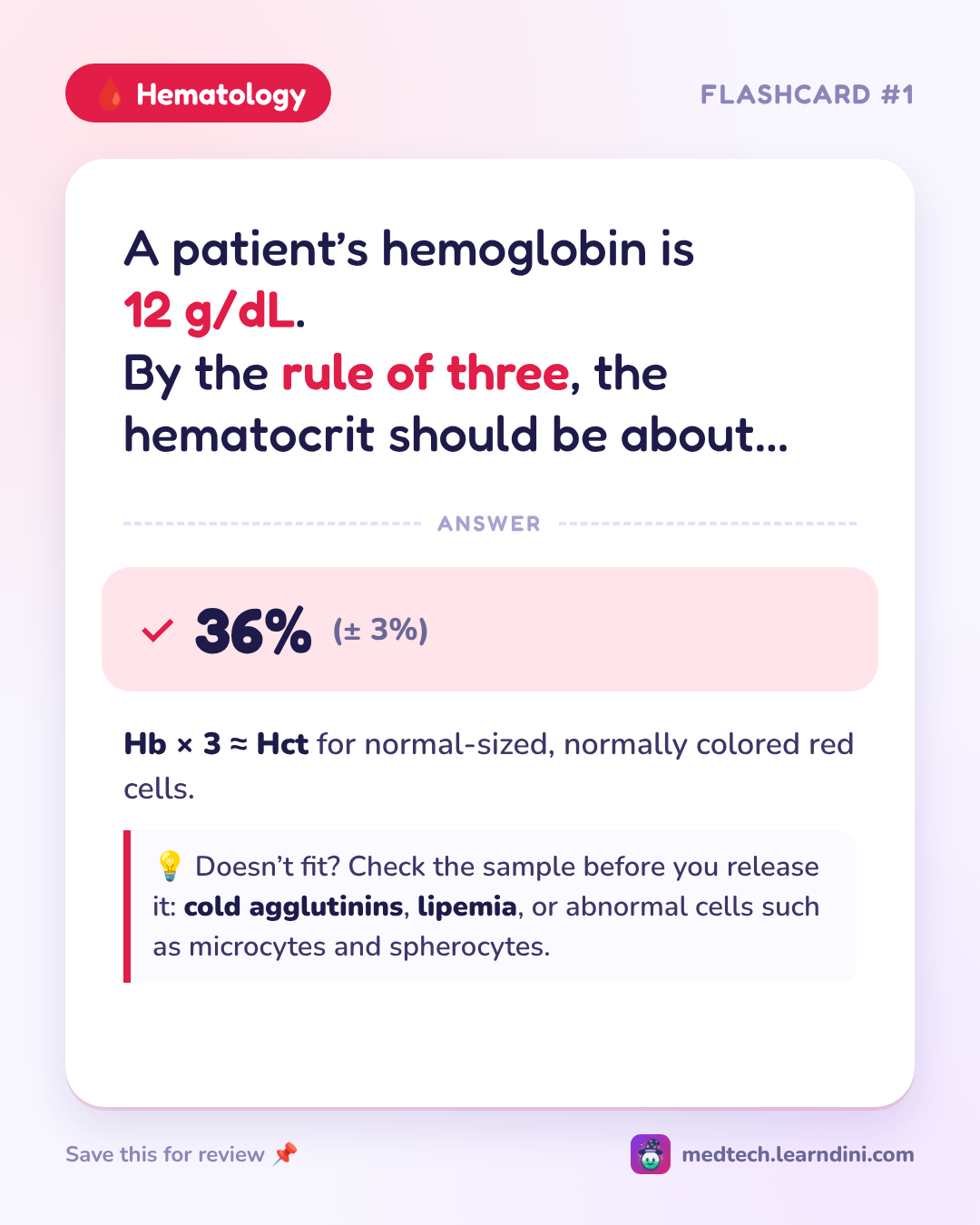
A patient’s hemoglobin is 12 g/dL.
By the rule of three, the hematocrit should be about…

Show answerHide answer
βœ“36%(Β± 3%)

Hb Γ— 3 β‰ˆ Hct for normal-sized, normally colored red cells.

πŸ’‘ Doesn’t fit? Check the sample before you release it: cold agglutinins, lipemia, or abnormal cells such as microcytes and spherocytes.
πŸ§ͺ UrinalysisFLASHCARD #2

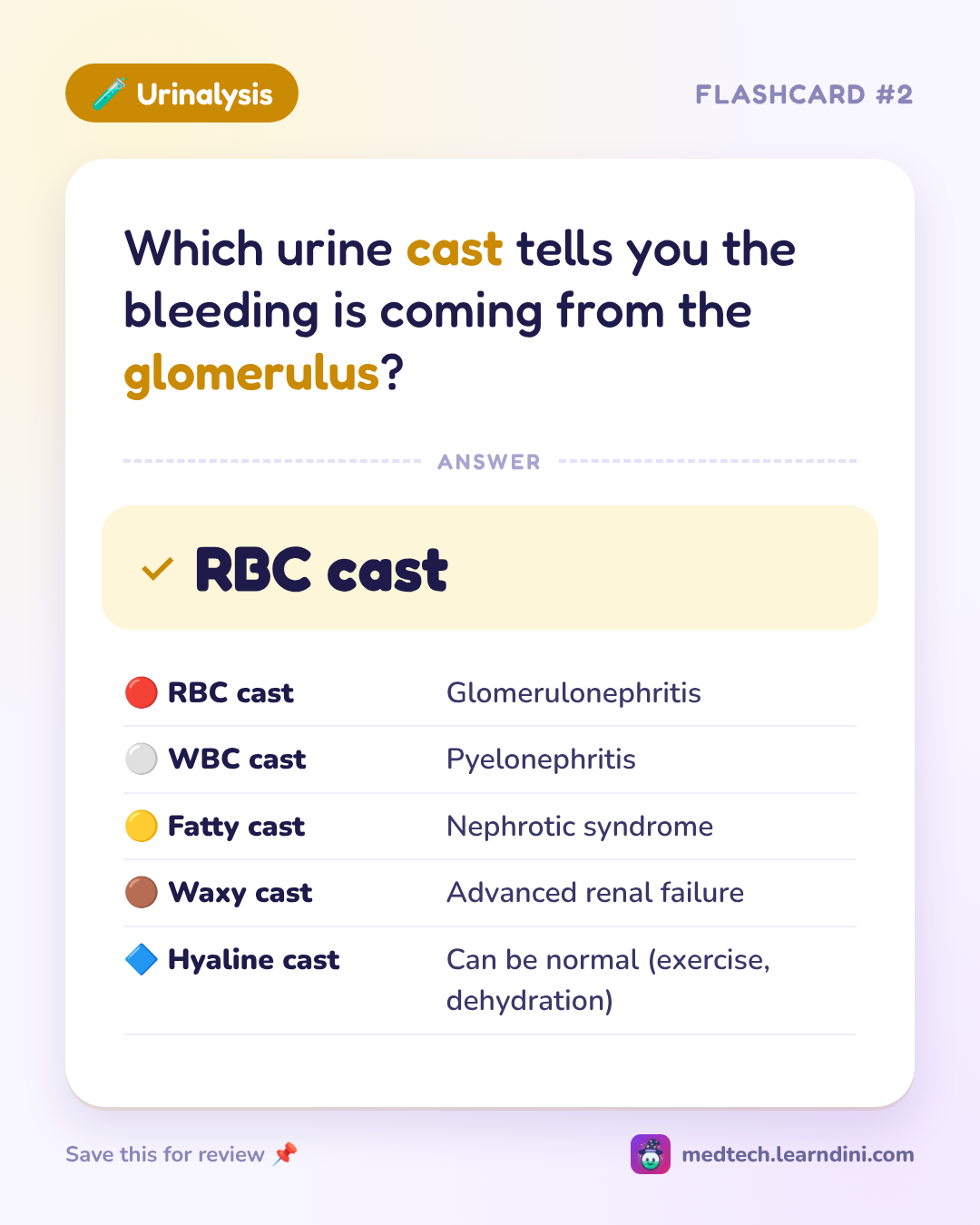
Which urine cast tells you the bleeding is coming from the glomerulus?

Show answerHide answer
βœ“RBC cast
πŸ”΄ RBC castGlomerulonephritis
βšͺ WBC castPyelonephritis
🟑 Fatty castNephrotic syndrome
🟀 Waxy castAdvanced renal failure
πŸ”· Hyaline castCan be normal (exercise, dehydration)
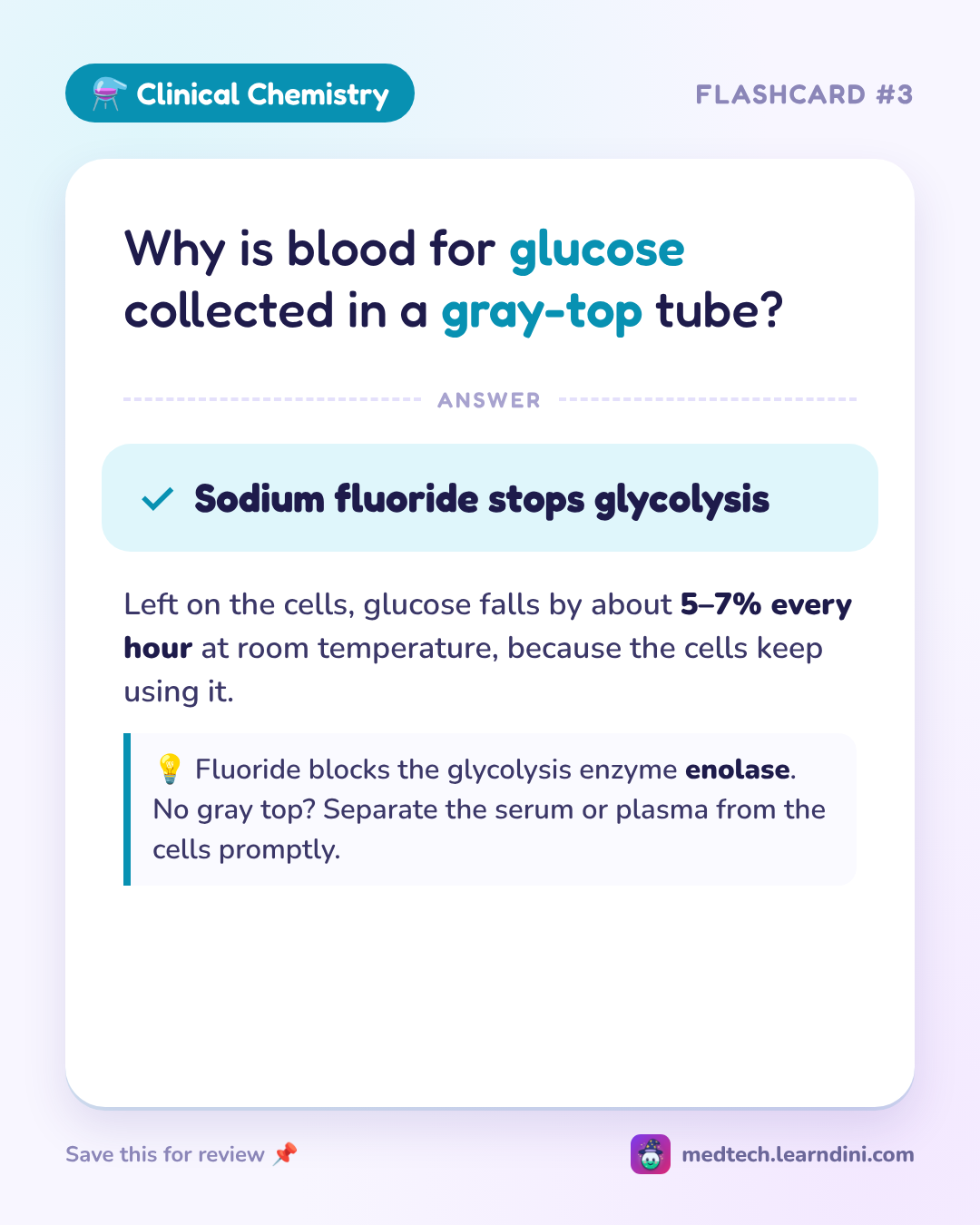
βš—οΈ Clinical ChemistryFLASHCARD #3

Why is blood for glucose collected in a gray-top tube?

Show answerHide answer
βœ“Sodium fluoride stops glycolysis

Left on the cells, glucose falls by about 5–7% every hour at room temperature, because the cells keep using it.

πŸ’‘ Fluoride blocks the glycolysis enzyme enolase. No gray top? Separate the serum or plasma from the cells promptly.

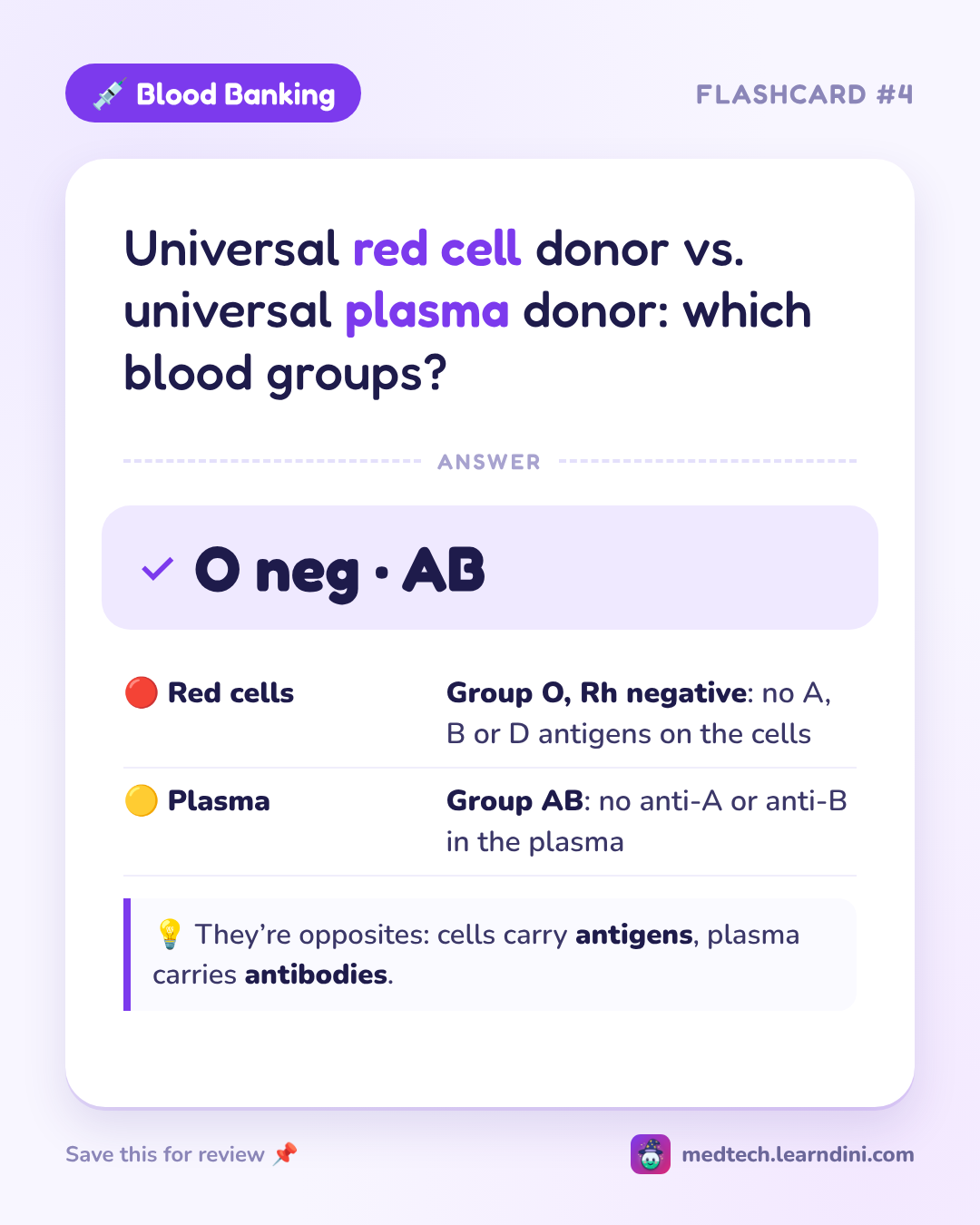
πŸ’‰ Blood BankingFLASHCARD #4

Universal red cell donor vs. universal plasma donor: which blood groups?

Show answerHide answer
βœ“O neg Β· AB
πŸ”΄ Red cellsGroup O, Rh negative: no A, B or D antigens on the cells
🟑 PlasmaGroup AB: no anti-A or anti-B in the plasma

πŸ’‘ They’re opposites: cells carry antigens, plasma carries antibodies.

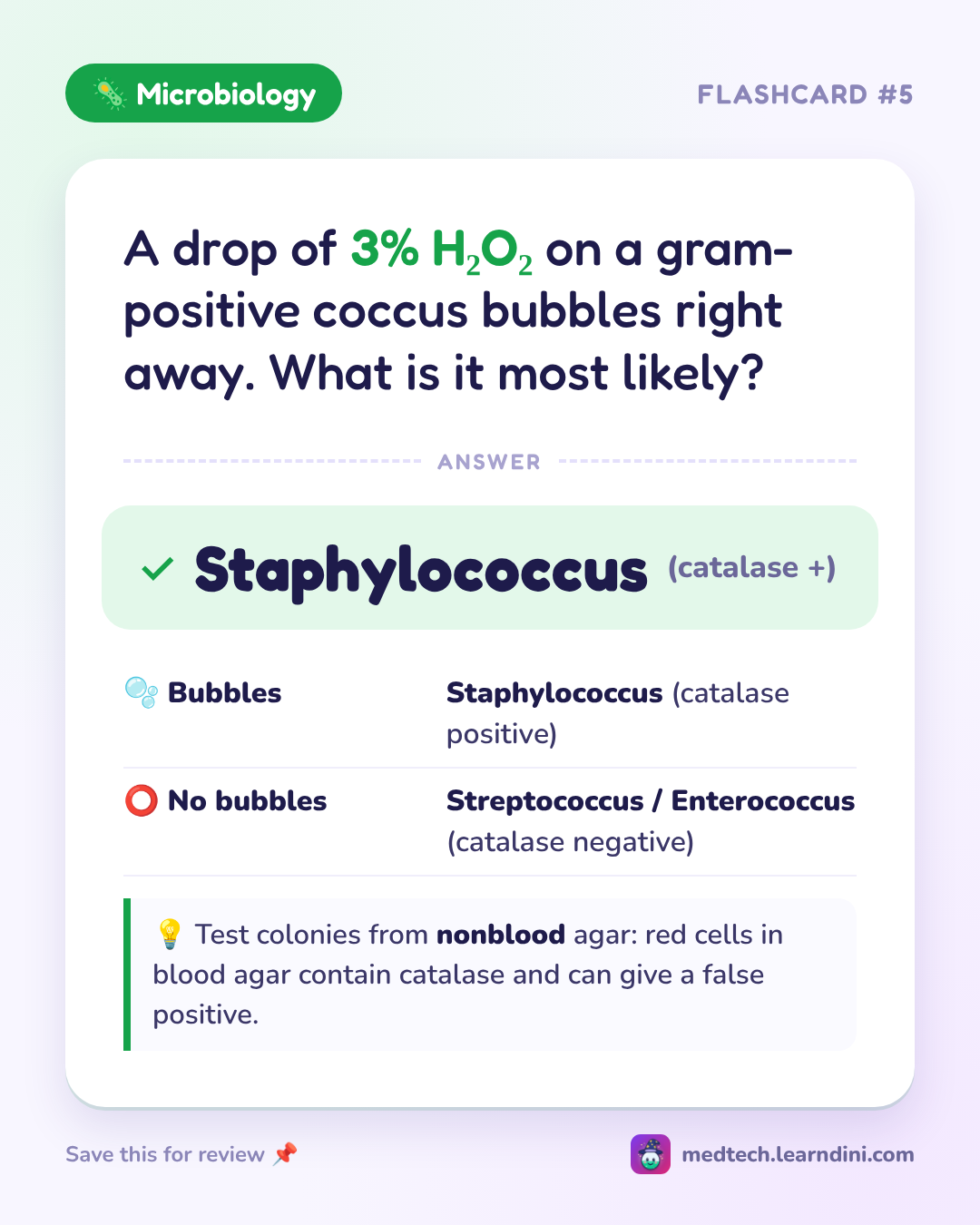
🦠 MicrobiologyFLASHCARD #5

A drop of 3% Hβ‚‚Oβ‚‚ on a gram-positive coccus bubbles right away. What is it most likely?

Show answerHide answer
βœ“Staphylococcus(catalase +)
🫧 BubblesStaphylococcus (catalase positive)
β­• No bubblesStreptococcus / Enterococcus (catalase negative)

πŸ’‘ Test colonies from nonblood agar: red cells in blood agar contain catalase and can give a false positive.

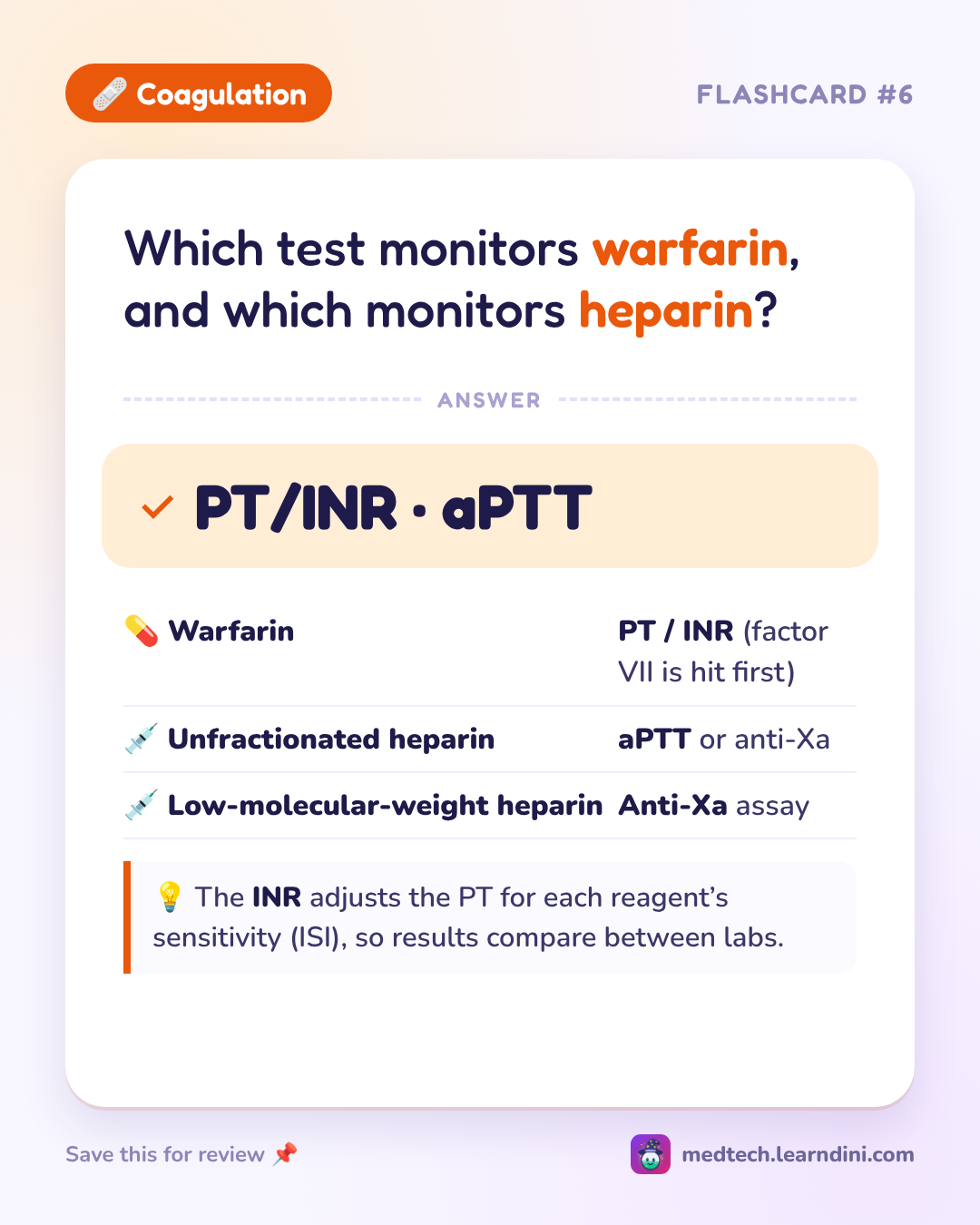
🩹 CoagulationFLASHCARD #6

Which test monitors warfarin, and which monitors heparin?

Show answerHide answer
βœ“PT/INR Β· aPTT
πŸ’Š WarfarinPT / INR (factor VII is hit first)
πŸ’‰ Unfractionated heparinaPTT or anti-Xa
πŸ’‰ Low-molecular-weight heparinAnti-Xa assay

πŸ’‘ The INR adjusts the PT for each reagent’s sensitivity (ISI), so results compare between labs.

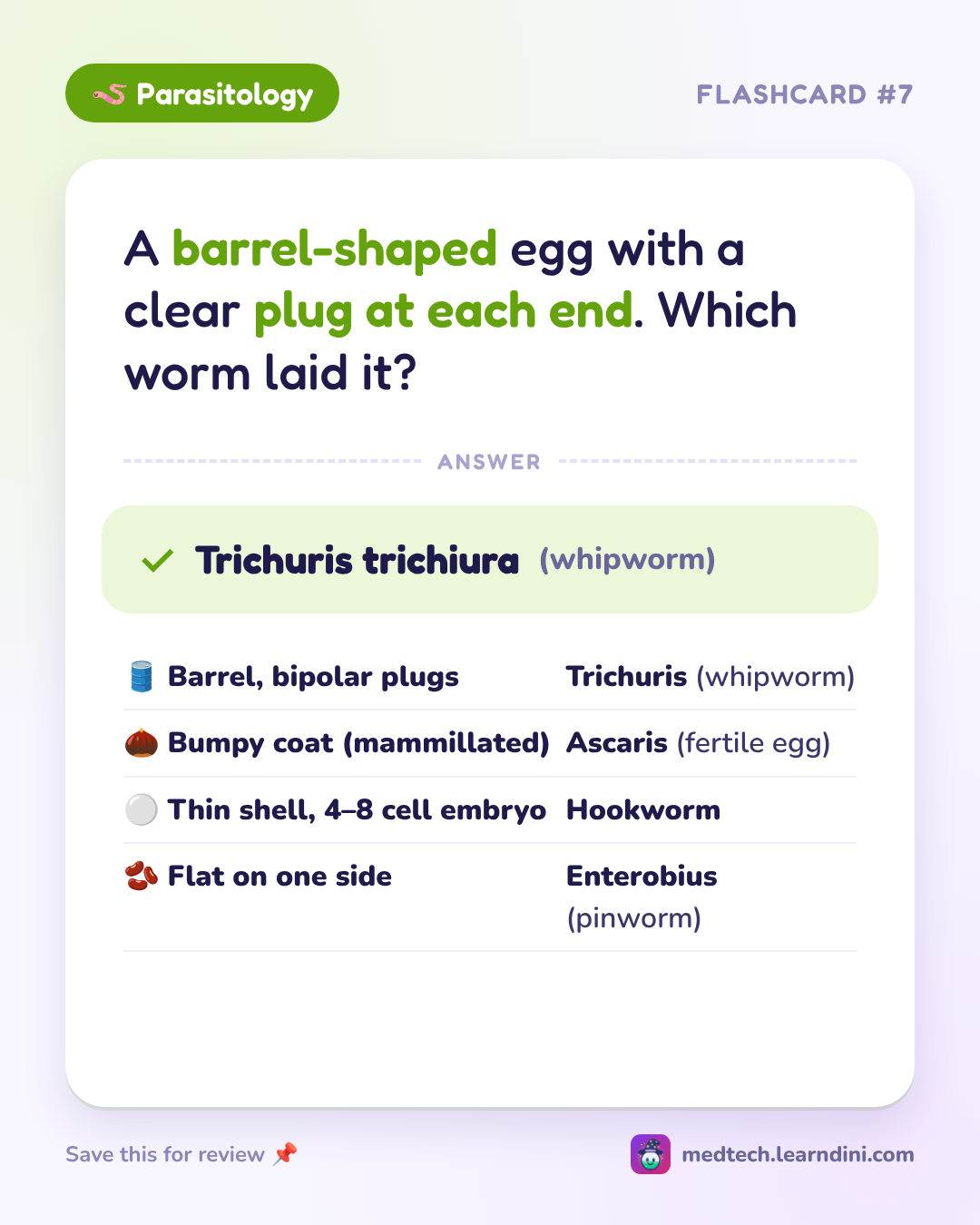
πŸͺ± ParasitologyFLASHCARD #7

A barrel-shaped egg with a clear plug at each end. Which worm laid it?

Show answerHide answer
βœ“Trichuris trichiura(whipworm)
πŸ›’οΈ Barrel, bipolar plugsTrichuris (whipworm)
🌰 Bumpy coat (mammillated)Ascaris (fertile egg)
βšͺ Thin shell, 4–8 cell embryoHookworm
🫘 Flat on one sideEnterobius (pinworm)
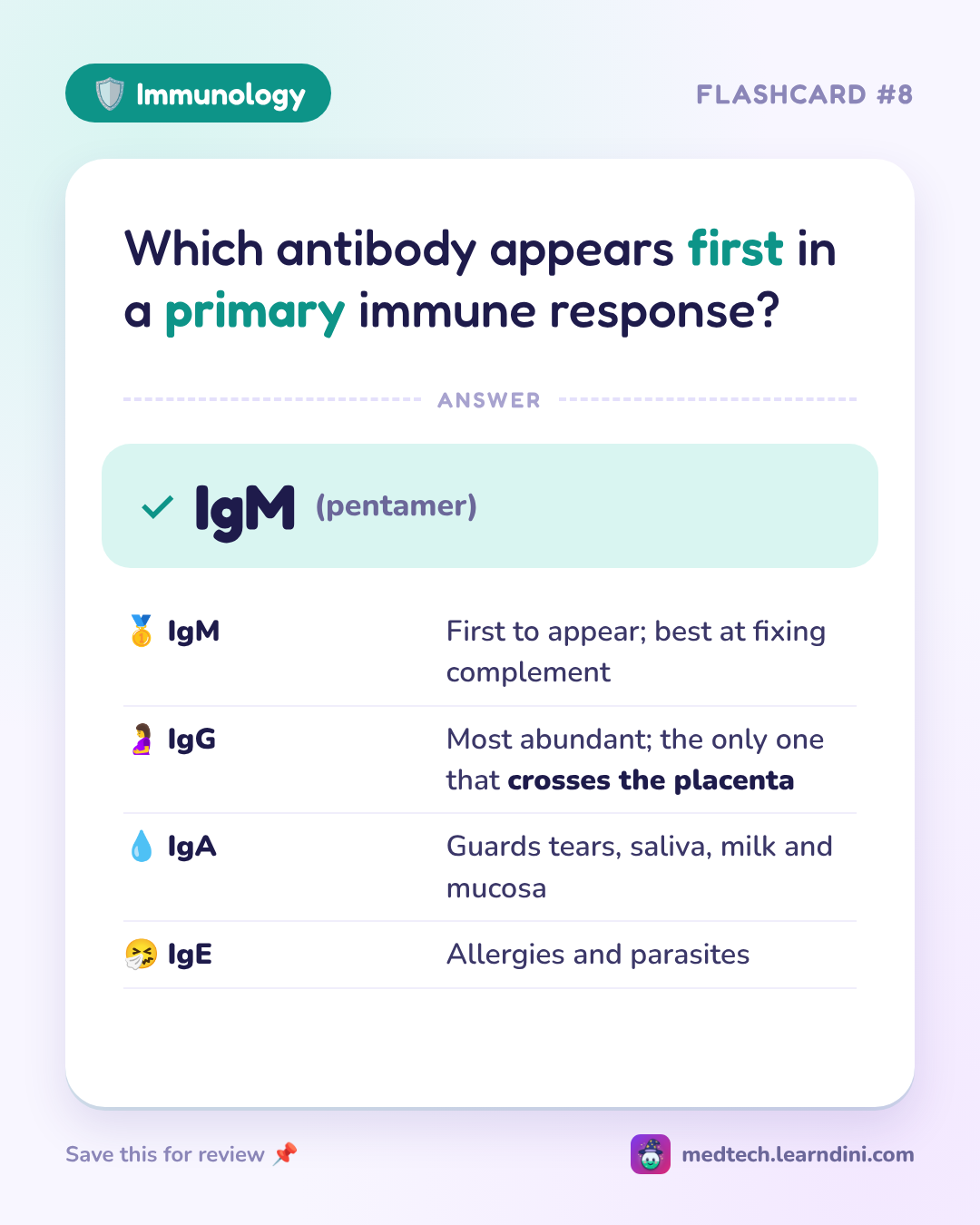
πŸ›‘οΈ ImmunologyFLASHCARD #8

Which antibody appears first in a primary immune response?

Show answerHide answer
βœ“IgM(pentamer)
πŸ₯‡ IgMFirst to appear; best at fixing complement
🀰 IgGMost abundant; the only one that crosses the placenta
πŸ’§ IgAGuards tears, saliva, milk and mucosa
🀧 IgEAllergies and parasites
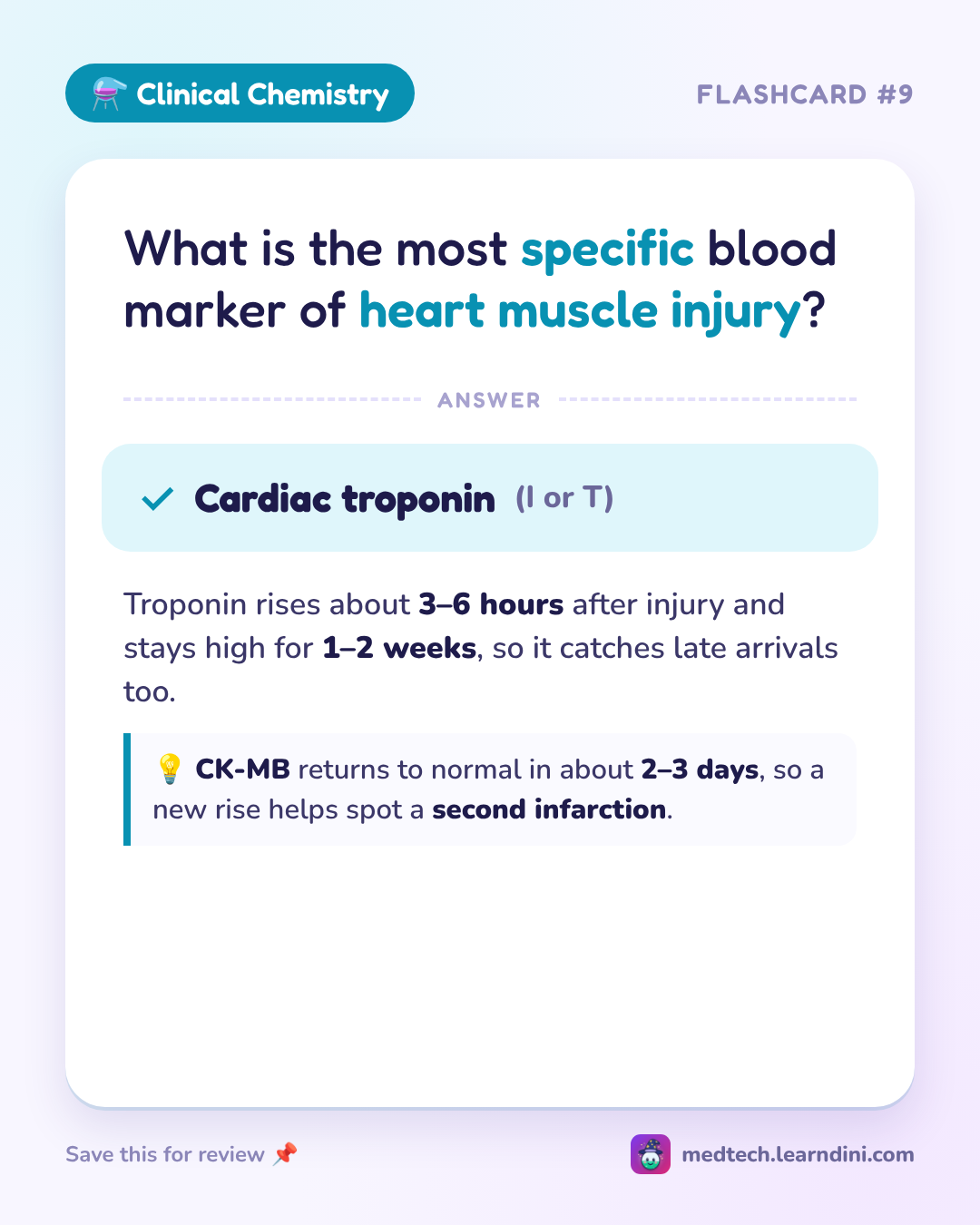
βš—οΈ Clinical ChemistryFLASHCARD #9

What is the most specific blood marker of heart muscle injury?

Show answerHide answer
βœ“Cardiac troponin(I or T)

Troponin rises about 3–6 hours after injury and stays high for 1–2 weeks, so it catches late arrivals too.

πŸ’‘ CK-MB returns to normal in about 2–3 days, so a new rise helps spot a second infarction.

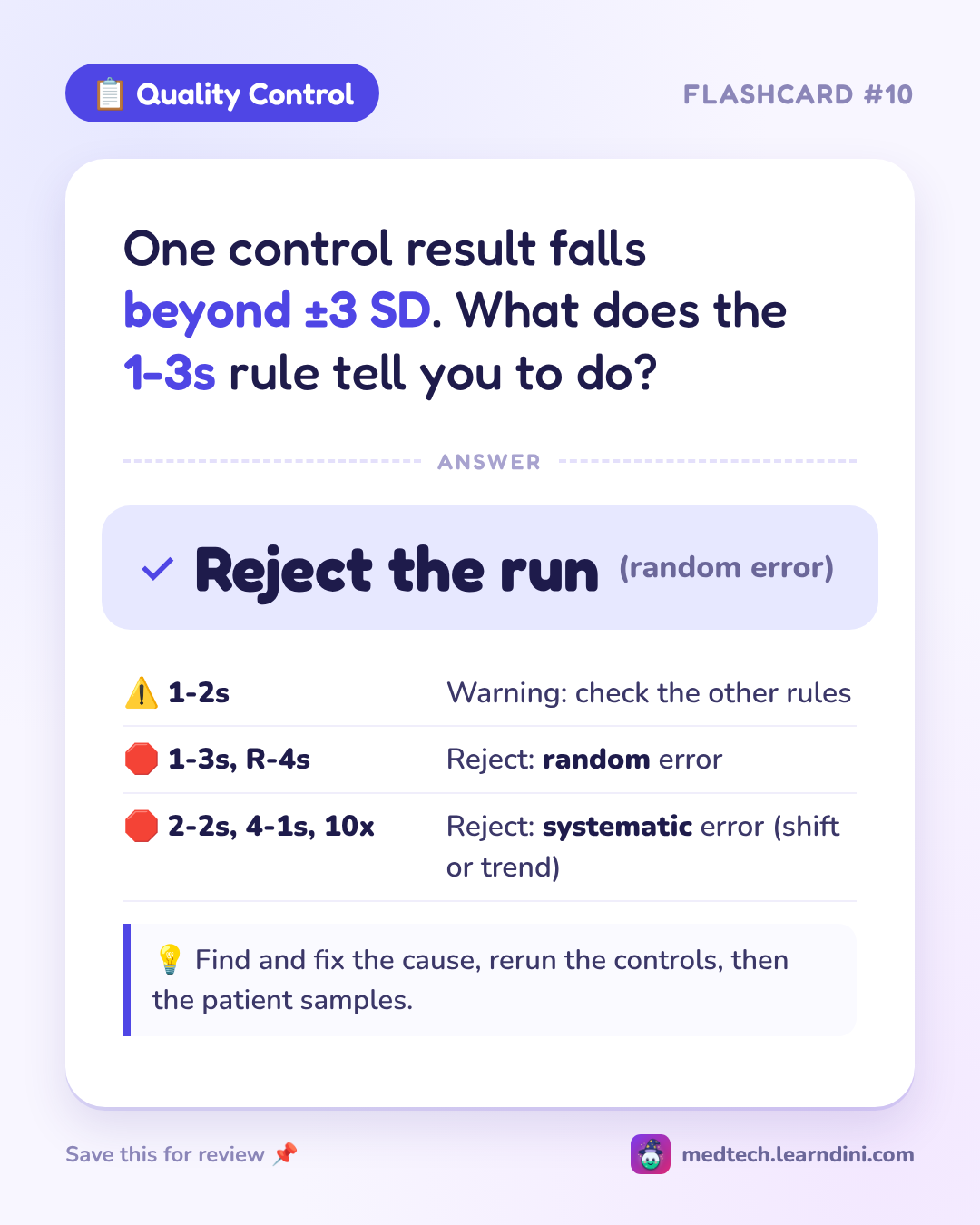
πŸ“‹ Quality ControlFLASHCARD #10

One control result falls beyond Β±3 SD. What does the 1-3s rule tell you to do?

Show answerHide answer
βœ“Reject the run(random error)
⚠️ 1-2sWarning: check the other rules
πŸ›‘ 1-3s, R-4sReject: random error
πŸ›‘ 2-2s, 4-1s, 10xReject: systematic error (shift or trend)

πŸ’‘ Find and fix the cause, rerun the controls, then the patient samples.